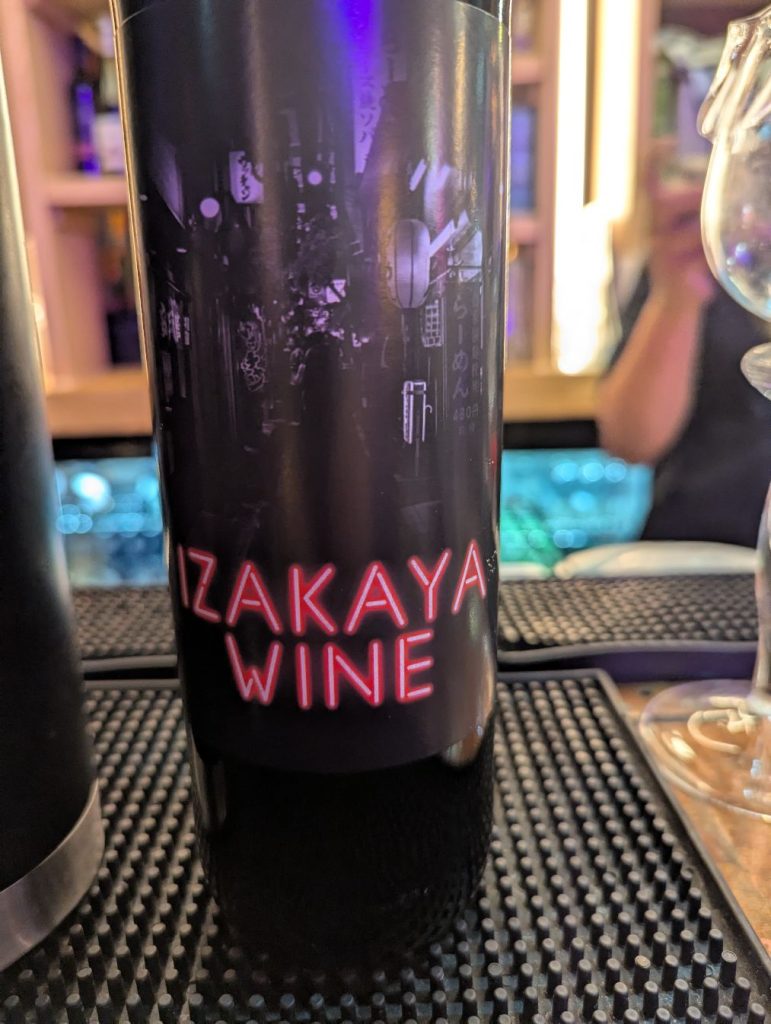
Last week I was in London and ate at Maki & Ramen in Soho. I’m becoming increasingly sceptical about ordering wine when eating out, partly because I’ve been disappointed too many times, and partly because some of the mark-ups are eye-watering.
This time, though, I tentatively ordered the Izakaya Red from Portugal, described on the drinks list as “Specially made to compliment Japanese Cuisine”. It turned out to be a bit of a good surprise.
The wine is Vinho Tinto by Caves Campelo in Portugal. The back label goes even further, declaring it “The Ultimate Wine for Asia Cuisine”. It also describes it as a “Grenade color” wine, which had me slightly puzzled. I suspect this is a translation of “garnet colour”, rather than suggesting anything explosive.
There’s no indication of the grapes or vintage, and it comes in at 12% abv. My best guess is that the blend is likely to include Touriga Franca and Tinta Roriz, the latter also known as Tempranillo.
In the glass it was very deeply coloured, with lovely vanilla and liquorice aromas. Smooth to drink, with pepper, cherry, cigar and vanilla coming through, low tannins and a flavour that lingered nicely and went excellently with the food.
It made me think about the whole idea of wine being made for food, rather than simply paired with it. We talk endlessly about pairing the right bottle with a particular dish, but what might be possible if winemakers started at the other end of the equation? What if the food itself, or even a whole style of cuisine, was part of the thinking from the beginning?
At £5.10 for 175ml or £7.10 for 250ml at Maki & Ramen in Soho, London, it was very reasonably priced too. You can easily pay twice that for a glass of wine in London. It was also served in a large, very smart wine glass, not a small, thick glass filled to near the brim. And, while I’m not looking to get into restaurant reviews, I will say the food was very affordable and tasty.