I have previously explored aspects of UK Alcohol Duty in my articles Increases in UK Wine Duty, Alcohol Reductions and Do You Want a ‘Watered’ Down Version of a Wine? Here is a detailed analysis of what has happened.
The UK’s 2023–2026 alcohol duty reforms transformed the domestic wine market by shifting taxation from a flat volume fee to a graduated tax based strictly on alcohol strength. To minimise these escalating financial penalties and keep retail prices stable, some commercial producers have widely adopted industrial product reformulation and de-alcoholisation techniques like reverse osmosis to lower their beverages’ ethanol content.
This large-scale corporate shift has caused some consumer backlash over strength dilutions, altered taste profiles and increased reliance on artificial additives. The legislation triggered significant macroeconomic trade distortions, including administrative supply chain friction, cost disadvantages for warm-climate wine imports and unintended drops in overall public tax revenues. It further divides the wine market into a hyper-engineered commercial tier focused on duty optimisation and a premium tier that absorbs higher tax burdens to preserve natural wine composition. Read on to learn more.
Changes to Alcohol Duty
On 1 August 2023, HM Revenue and Customs (HMRC) implemented a structural overhaul of the United Kingdom alcohol duty system, replacing a historical regime that had taxed wines using broad, flat volume categories. Under the former mechanism, still, sparkling, and fortified wines were assessed fixed duty rates per bottle regardless of minor variations in strength. The 2023 reform established a standardised system where excise duty is calculated directly proportional to Alcohol by Volume (ABV), converting the taxation model into a graduated tax on pure ethanol content.
Recognising the economic shock this transition posed to the wine industry, where agricultural and climatic factors produce natural alcohol variations between 8.5% and 15.0% ABV, the government established a temporary transitional “wine easement”. Active for 18 months from 1 August 2023, to 1 February 2025, this mechanism treated all still and sparkling wines between 11.5% and 14.5% ABV as if they contained an assumed strength of 12.5% ABV, subjecting them to a flat duty of £2.67 per 75cl bottle.
The expiration of the wine easement on 1 February 2025, alongside Retail Price Index (RPI) inflation uprating, fundamentally altered the economics of wine distribution in the UK. From February 2025 onward, excise duty on all wine between 8.5% and 22% ABV became payable on actual strength, assessed per 0.1% ABV increment. A subsequent RPI-linked uprating on 1 February 2026, raised the base rate for products in the 8.5%–22% ABV band, widening the tax gap across different strength tiers.
From 1 February 2026, UK wine duty was calculated according to alcohol strength. For a standard 75cl bottle, duty ranges from £1.95 at 8.5% ABV to £3.44 at 15% ABV, with an additional 20% VAT charged on the duty-inclusive price. Every 0.5 percentage point increase in ABV adds approximately 11p–12p in tax per bottle.
The reforms have significantly increased taxation on stronger wines. Before August 2023, wines at 11.5% and 14.5% ABV attracted the same £2.23 duty. By February 2026, duty on a 14.5% ABV bottle had risen to £3.33, an increase of approximately 49%. This strength-based taxation system has created a strong financial incentive for commercial wine producers to reduce alcohol levels to minimise duty costs and protect retail margins.
Brand Reformulation Strategies
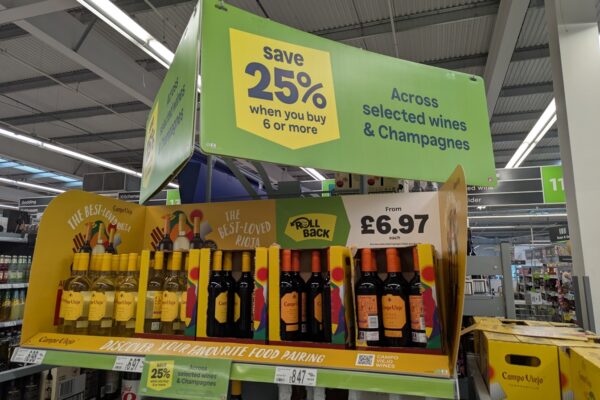
To prevent rising tax liabilities from eroding gross margins or pushing retail shelf prices above key price points, major wine brand owners initiated widespread product reformulations. Colloquially termed “drinkflation,” this practice involves systematically reducing ethanol percentages to lower excise charges.
Commercial strategies focused on targeting specific fiscal thresholds. During the easement period, brands lowered strengths below 11.5% ABV to access lower tax rates than the flat £2.67 easement rate. Following the expiration of the easement, producers optimised products around the 10.5% and 11.0% ABV marks, or dropped strengths to the 8.5% ABV threshold, the absolute statutory limit for standard wine classification under European and UK regulations.
Examples
Hardys Stamp Shiraz Cabernet provides a clear example of commercial re-engineering in response to the duty changes. Traditionally bottled at 13.5% ABV to preserve the full-bodied mouthfeel of warm-climate Australian reds, the product was reformulated down to 11.0% ABV. This 2.5 percentage point drop generated a tax saving of roughly 57p per bottle under 2026 rates (£2.53 versus £3.10 duty), allowing the brand to maintain promotional shelf placements around £5.25 in major supermarket chains like Tesco.
Barefoot White Zinfandel underwent a structural reduction, moving from an 11.0% ABV baseline down to 8.5% ABV. By reducing the alcohol content to the lowest allowable threshold for standard wine, the brand owner lowered the duty burden to £1.95 per bottle. Even as the retail price rose from £5.25 to £5.75, the reduced ethanol content helped protect profit margins despite broader inflationary pressures.
Barefoot Soft & Fruity Red was similarly adjusted, dropping from 12.5% ABV down to 10.5% ABV. This 2.0 percentage point reduction reduced duty liabilities by approximately 46p per bottle under post-easement schedules, removing the product from mid-tier duty rates.
Blossom Hill Rosé lowered its alcohol content from 11.0% down to 10.5% ABV. While a half-percent drop appears modest, across high-volume production runs it yields a tax saving of roughly 12p per unit, illustrating how commercial bottlers optimise product formulations around fractional tax thresholds.
Dealcoholisation and Sensory Alterations
Lowering the alcohol content of wine requires viticultural, chemical, or physical intervention. Ethanol plays a fundamental structural role in wine, serving as a primary solvent that carries volatile aromatic esters, provides body and viscosity and balances natural organic acids and astringent polyphenols. Removing ethanol alters the wine, requiring post-fermentation processing to manage quality loss.
Physical Separation Technologies
Large-scale commercial dealcoholisation relies on physical separation technologies authorised under International Organisation of Vine and Wine (OIV) standards:
Spinning Cone Column (SCC): A specialised vacuum distillation system utilising alternating stationary and rotating cones to create a liquid film less than 1 mm thick. Operating under high vacuum (0.04 atm), the process runs in two distinct stages. In the first stage at 26°C–28°C, delicate volatile aroma compounds are stripped and captured in a concentrated spirit fraction accounting for roughly 1% of total volume. In the second stage at 38°C, ethanol is removed from the remaining base wine. The saved aroma fraction is subsequently blended back into the dealcoholised liquid. While SCC offers short processing times (<20 seconds thermal exposure), the extraction process often leaves the wine with sharp perceived acidity and reduced palate weight.
Reverse Osmosis (RO): A pressure-driven membrane separation technique where wine is forced across dense polyamide membranes. Ethanol and water pass through the membrane as a permeate, while colour compounds, tannins, organic acids, and sugars are retained in the retentate. The permeate is then distilled or diluted to strip ethanol before being recombined with the retentate. Sensory panel evaluations show that RO preserves fruit flavour and natural sweetness better than basic vacuum distillation, though it requires longer processing times and carries a risk of membrane fouling.
Vacuum Distillation (VD): Operates by lowering atmospheric pressure inside evaporator units to boil off ethanol at 25°C–30°C. While less capital-intensive than SCC, unassisted vacuum distillation strips lighter aromatic esters along with the ethanol, often leaving the resulting liquid with a flat flavour profile and watery texture.
Wine Re-engineering
Extracting ethanol disrupts the balance between ethanol, water, glycerol, and organic acids. When alcohol is dropped from 13.5% down to 10.5% or 8.5% ABV, the liquid loses sweetness perception and viscosity, unmasking tartaric and malic acids as well as astringent tannins.
To counter these sensory defects, commercial bottlers use additives. Producers frequently dose lower-ABV wines with rectified concentrated grape must (RCGM) to reintroduce unfermented sugar, which masks thinness and harsh acidity. Additionally, hydrocolloids such as acacia gum (gum arabic) and potassium polyaspartate are added alongside tartaric, citric, or ascorbic acids. These compounds simulate physical mouthfeel, stabilise tartrates, and protect low-alcohol wine against oxidation.
Consumer Criticism
The quick wave of product reformulations prompted widespread criticism from retail consumers and wine industry commentators. Shopper feedback across major supermarket channels highlights four primary drivers of consumer discontent: stealth reductions, degraded taste profiles, decoupling of price from quality and increased reliance on additive ingredients.
Sensory and Transparency Grievances
Consumer criticism centered on the stealthy execution of ABV reductions. Many shoppers reported purchasing familiar brand labels, such as Hardys Stamp or Blossom Hill, only to discover post-purchase that the liquid’s strength had been quietly lowered from 13.5% to 11.0% or 10.5% ABV. Buyers expressed frustration that front labels rarely highlighted these changes, arguing that brand owners were reducing product quality rather than giving consumers a clear choice to pay a higher price for the original formulation.
Complaints over the structure of the wine were equally pronounced. Shoppers described reformulated lower-ABV wines as “watery,” “thin,” and lacking structural body. Red wine consumers expressed particular dissatisfaction, as styles like Shiraz and Cabernet Sauvignon depend on higher ethanol levels to balance structural tannins and deliver fruit depth. Dropping these red wines to 11.0% ABV often resulted in a thin liquid dominated by harsh acidity and aggressive tannins.
Dissatisfaction was further heightened by retail price increases occurring alongside ABV reductions. The reformulation of Barefoot White Zinfandel, dropping from 11.0% to 8.5% ABV while its shelf price rose from £5.25 to £5.75, led consumers to criticise paying higher prices for diluted products, with some comparing the reformulated liquid to carbonated fruit drink.
Shoppers also noted expanded back-label ingredient lists. Wines that previously contained only fermented grape juice began explicitly listing additive compounds, including acacia gum, potassium polyaspartate, concentrated grape must, and added organic acids, raising concerns over industrial ultra-processing in commercial wines.
Wine writers and trade critics, including Jancis Robinson MW, Tim Atkin MW, and Gavin Quinney, noted that duty increases disproportionately impact budget wines retailing under £7.00. In this value segment, fixed duty charges and VAT account for over 50% to 60% of the shelf price, leaving only a small fraction of the retail cost for the underlying liquid. Conversely, premium wines selling above £20.00 absorb tax changes far more easily, preserving their natural alcohol levels and traditional winemaking integrity.
Macroeconomic Analysis and Trade Distortions
The structural shift in UK alcohol taxation has generated secondary economic consequences across supply chain operations, international trade relationships, and public revenue generation.
Prior to August 2023, UK importers and wholesalers managed wine duty across three flat tax categories. Under the current system, duty is spread across more than 100 discrete tax tiers defined per 0.1% ABV increment between 8.5% and 22% ABV.
Because wine is an agricultural product influenced by seasonal weather, grape natural sugar levels vary from year to year. A vineyard producing a Pinot Grigio at 12.1% ABV in a cool vintage may produce a 12.6% ABV wine in a warmer year. Under the current tax system, a half-percent natural variance alters the duty liability by 11p per bottle plus VAT, forcing importers and distributors to continually revise stock keeping units, pricing structures, and compliance software. Wholesale distributors have had to adopt quarterly ABV audits to manage shifting tax liabilities across their portfolios.
The duty reforms demonstrate the operational limits of using excise taxation to boost public revenue, illustrating Laffer Curve dynamics in consumer markets.
The government enacted strength-based taxation and RPI increases to grow public receipts while discouraging excessive consumption. However, the higher tax rates led to reduced sales volumes and widespread product reformulation, which dampened overall duty collections. Published HMRC receipts reveal that alcohol duty collections between April and December 2024 fell by over £200 million compared to the same period in 2023. In response, the Office for Budget Responsibility (OBR) lowered its long-term annual alcohol duty forecast from £13.1 billion down to £11.9 billion.
The strength-based duty regime acts as an indirect tariff on warm-climate wine-producing nations. Regions such as Australia’s Barossa Valley, Argentina’s Mendoza, South Africa’s Stellenbosch, and France’s Southern Rhône naturally produce grapes with high sugar levels, resulting in finished wines that ferment to 14.0%–15.0% ABV.
By assessing higher duty rates on these alcohol levels (£3.22 to £3.44 per bottle), the UK tax system places warm-climate imports at a cost disadvantage compared to cooler European regions (e.g., Germany, Northern France, or domestic English producers) whose wines ferment naturally at lower strengths between 10.5% and 12.0% ABV (£2.41 to £2.76 per bottle).
Conclusions
The evolution of the UK alcohol duty regime between 2023 and 2026 provides yet another example of the unintended consequences of successive governments interfering in markets and industries they appear to understand only superficially. By linking excise duty directly to alcohol strength, policymakers have imposed an artificial commercial incentive to reduce alcohol levels, encouraging widespread ‘drinkflation’ and fundamentally altering products that consumers had previously been content to buy.
Although technologies make it possible to remove alcohol with considerable precision, this does not mean that the resulting wine remains unchanged. The removal of ethanol can compromise body, balance and flavour, often accentuating acidity and diminishing the characteristics that made the original wine appealing. Consumers are consequently being offered increasingly manipulated products, frequently without a clear understanding of what has changed or why.
The wider economic consequences are equally questionable. An already complicated tax regime has become more administratively burdensome, producers in warmer wine-growing regions face a structural disadvantage and higher duty rates have coincided with declining market volumes and disappointing tax receipts. Meanwhile, the market is being driven towards an increasingly artificial division between mass-market wines engineered to minimise tax liabilities and premium wines whose producers and customers must absorb higher costs simply to retain the product’s original character.
The Future
Some supermarkets are listening to their customers and are re-introducing higher alcohol, lower price products. For example, at a recent press tasting, Morrisons specifically introduced its new Wattleford range. Meanwhile, the UK Government is undertaking an Evaluation of UK Alcohol Duty Reforms.
Further Reading
UK Alcohol Duty, Wine Tax and Government Policy
WSTA Alcohol Duty Rate Tables – Wine and Spirit Trade Association
Reform of Alcohol Duty Rates and Reliefs – GOV.UK
Your Guide to UK Tax on Wine – Gavin Quinney
What Will Happen to the Tax on Wine from 1 February 2025? – House of Commons Library
WSTA Briefing: Alcohol Duty and Budget 2024 – Wine and Spirit Trade Association
UK Wine Duty Rates 2026: Per Bottle Table – Franc Wine
Alcohol Duty Uprating – GOV.UK
UK Alcohol Duty – Lanchester Wines
UK Alcohol Duty Change – February 2025 – Alexander Wines
A Guide to UK Duty Hikes on Wine – Gavin Quinney
The Budget – UK Duty on Wine – Gavin Quinney
UK Alcohol Duty Rises Today – Jancis Robinson
Wine Market Trends and Changing Alcohol Levels
UK Wine Market Size, Share, Trends, Growth and Report 2034 – IMARC Group
Carlsberg Joins Rush to Reduce ABV as Duty Reform Comes into Force – The Drinks Business
Tesco Shoppers Slam Reduced Wine ABVs – The Drinks Business
Pulling in the Same Direction – Online Wine Club
The Wine Merchant – Issue 135 – The Wine Merchant
Low-Alcohol Wine and Alcohol Reduction Techniques
Low Alcohol Wine – ThirtyFifty
Alcohol Reduction: Spinning Cone Column and Reverse Osmosis – WineWiki
Wine Dealcoholisation: Techniques, Regulations and Solutions – Ever
Lowering Wine Alcohol Content by Reverse Osmosis and Spinning Cone Columns: Effects on Sensory Characteristics – ResearchGate
Comparison of the Principal Production Methods for Dealcoholised Wine Based on Analytical Parameters – OENO One
The Spinning Cone Column Alcohol Adjustment – Full Strength Wines
Commercial Wine Alcohol Reduction Strategies – Winequip