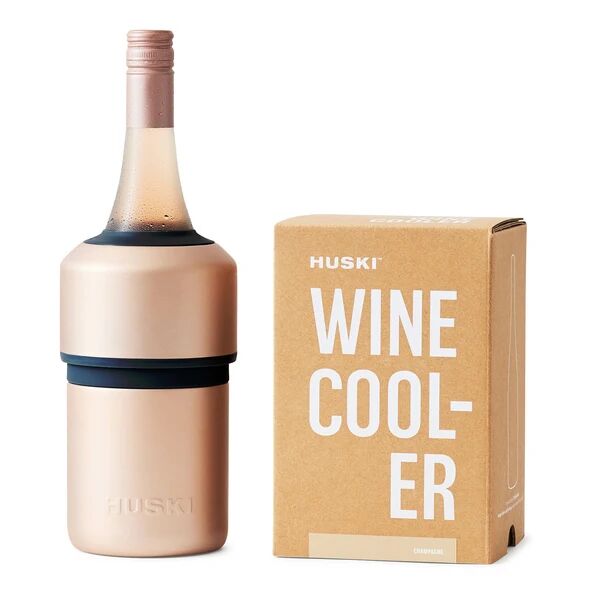
Huski Wine Cooler

Posted by

A Huski Wine Cooler was bought for me by my wife as a gift. I have to admit that I was guilty of not looking at it particularly closely when I first received it. We already have several wine coolers, so I assumed it was simply another variation on something I already had. As it turned out, it was very different and an excellent gift.

Huski describes it as an award-winning, high-performance cooler, designed to keep drinks chilled for up to six hours without the need for ice. It certainly isn’t cheap. On the official Huski UK website it sells for around £49.99 to £54.99, depending on the colour. So what exactly is it, and does it actually work?

Designed in New Zealand, the Huski is essentially a triple-insulated stainless-steel container with a screw-on top. You simply place your bottle of wine inside and screw the top down around the neck of the bottle. The thread is deliberately quite wide, so it doesn’t require endless turning. As you tighten it, a rubber seal at the top closes around the bottle and holds it securely in place.

I tried it with a wide range of bottles and everything I had fitted, including several champagne and sparkling-wine bottles. That versatility immediately made it more useful than I had expected.

The important question, though, is whether it actually keeps wine cold. It does. Remarkably well. That is unquestionably the Huski’s main strength. Once a properly chilled bottle is placed inside, it maintains the temperature extremely effectively. Unlike a conventional ice bucket, there is no noticeable change of temperature, there is no ice to deal with, no water collecting around the bottle and no wet bottle afterwards. It also completely eliminates condensation, so hands and tables stay dry.

There is a silicone base underneath the cooler which both protects surfaces and makes the Huski very stable. There is, however, a slight downside to this. The silicone grips the surface so well that you cannot easily rotate the bottle while opening it. If, like me, you sometimes rest a bottle on a worktop or table and rotate it while removing foil or using a corkscrew, you are better off opening the wine before putting it into the Huski. One other small thing. Unlike see-through plastic wine coolers, you obviously can’t see the back and front bottle labels. This is probably more of an issue for me than for the average drinker, as I sometimes need to reference the bottle while I’m reviewing the wine.

Huski also says the cooler is slim enough to allow you to pour comfortably with one hand. Technically it is, but personally I found it easier to use two hands most of the time. The additional size and weight around the bottle make one-handed pouring slightly less natural than pouring from a bottle on its own. Those are relatively minor criticisms, though.

The obvious uses for the Huski are BBQs, picnics, outdoor entertaining and dinner parties. For all of those situations it makes a great deal of sense. There is no ice to prepare or replenish and you can simply put a chilled bottle inside and forget about it.

However, I’ve actually found its best use to be at home, where it has become the perfect partner for my wine fridge. A wine fridge is excellent because it allows you to bring wine to exactly the temperature you want without having to play around with timings in a normal refrigerator. The problem comes once you open the bottle. You pour a glass, put the bottle on the table and immediately it starts warming up. You can keep returning it to the wine fridge between pours, but that rather defeats the convenience of having the bottle on the table. Traditional wine coolers help, but in my experience they simply don’t maintain the temperature well enough.

I can take a bottle from the wine fridge at precisely the temperature I want, put it straight into the Huski and leave it on the table. The wine remains remarkably close to that ideal serving temperature as we drink it.

At around £50, the Huski Wine Cooler initially looks expensive for what appears to be a fairly simple product. I certainly wouldn’t have expected to become quite so enthusiastic about one. But it is beautifully made, easy to use, works with an impressive variety of bottle shapes and, most importantly, does exactly what it claims to do: it keeps wine cold extremely well without ice, water or condensation.

Given that my first one was a gift, perhaps the best recommendation I can give is that I’ve subsequently found myself buying another one. Ebay has several listed ‘new’ in the £20 to £26 price range.
Did You Know?

Nearly a third (32%) of UK consumers say they have already used AI for alcoholic drinks advice. More

Among socially active wine buyers, 37% have bought a wine recommended online. More

In 2026, 72% of consumers now think wine knowledge is essential to appreciation, up 20 percentage points on 2025. More

Rías Baixas wines reached more than 107 countries in 2025 and exports represented 31 per cent of the denomination’s total sales. More

Light Strike Can Cause Wine Degradation in Just One Day. More

People actively adjust their wine choices depending on who might see them. More

In the UK, 73% of Alcohol is Bought From Retail Rather Than Hospitality. More

UK wine production reached 124,377 hectolitres that year, meaning the UK accounted for roughly 0.05 per cent of world output. More

For Crémant, grapes must be harvested by hand and the wines must undergo at least nine months’ ageing before release. More

In 2024, the UK was the second-largest export market for Champagne globally, after the United States. More

Local UK bottling of wine represents about 40% of imported wine. More

Around 1% of people, typically severe asthmatics, have a sulphite sensitivity. More

A large 80% of Australian wine arrives in the UK in bulk. More

Only about 0.02% of Australia’s landmass is dedicated to vineyards. More

In 2024, New Zealand produced only 1% of the World’s wine. More

In 2024, the US imported 37% of World production of Pinot Grigio and the UK was is in second place at 27%. More

In 2024, the UK was South Africa’s largest export market, with 40% of total exports. More

In 2024, the United Kingdom imported 22.3 million bottles of Champagne, a decline of 12.7% compared to the previous year. More

Larger Champagne producers source grapes from as many as 80 different vineyards throughout Champagne. More

Champagne houses and growers collectively produce around 300 million bottles annually. More

In 2025, the Champagne region was home to about 2,124 Champagne houses and approximately 19,000 growers. More

Provence is one of the leaders in the conversion to organic viticulture, with 61% of vineyards certified. More

8% of the South Africa’s grape production is Fairtrade-certified. More

Up to 80% of wine aroma compounds come from grape skins. More

Glycerol is the third-largest component of most dry wines after water and alcohol which is why they so often feel ‘smooth’ or ‘silky’ in the mouth. More

Humans are more than 400 times more sensitive to bitter than sweet. More

Humans can detect the earthy molecule geosmin at about 100 parts per trillion and camels are so sensitive to it they can locate damp ground from roughly 50 miles away. More

During the phylloxera crisis of the nineteenth century, 90% of Europe’s vineyards were destroyed. More

In 2025, for La Vieille Ferme, also known as “The Chicken Wine”, sales surged by 49.4% to £110.8 million. More

In 2025, in the UK, Yellow Tail held the top position with sales, marking a 9.8% increase over the previous year. More

In 2024, the UK was the second-largest wine importer in volume and value. More

In 2024, the UK was the fifth-largest wine-consuming country globally. More

In 2025, global wine consumption continued its downward trend, estimated at 214.2 million hectolitres, the lowest since 1961. More

In 2025, online alcohol sales had a 20% increase in value over five years. More

In 2025, the number of UK vineyards rose to 1,104 and wineries to 238, with land under vine expanding to 4,841 hectares, a 510% increase since 2005. More

Moët Hennessy alone commands nearly 46.66% of the Champagne market, with the top three producers together holding about 61%, and the top five controlling over 72%. More

In 2024, the Champagne market was worth roughly €3.92 billion. More

In the marketing year 2023/24, white wine accounted for roughly 55% of Spain’s output, whereas red and rosé together made up about 45%. More

In the UK, 92% of wine is consumed within 48hrs of purchase. More

The majority of wines, 95%, use commercial rather than wild yeast. More

Between 0.5 and 10 litres of water, per litre of wine, are needed for cleaning during winemaking. More

Machine harvesting can achieve up to 100 tons of fruit per day vs 1 ton for a human. More

In Germany, 2025 was the smallest wine vintage since 2010. More

The majority of vineyards, 90% in 2019, are farmed with heavy chemical interventions. Only 6% are organic. More

90% of low and coastal areas in south Europe and California will no longer be able to produce good wine by the end of the century. More

IMAGE WALL