Jump straight to WineQuiz or learn more about it below.
To install on your phone, after opening the online app in Safari on iOS, use Share → Add to Home Screen. On Android, use Chrome’s Install app or Add to Home screen menu. Once installed and opened online at least once, WineQuiz works offline.
The idea for WineQuiz came about unexpectedly while I was on holiday. I found myself with too many hours to spare waiting for a flight and passed some of the time listening to wine podcasts. One in particular, The UK Wine Show, caught my attention. They had a clever way of keeping listeners engaged, posing a wine question at the beginning of an episode and revealing the answer at the end.
I liked this approach. The questions were often quite simple, but they challenged what I thought I knew, and I invariably learnt something new along the way. It got me thinking about whether a similar idea could be developed into something more interactive, using the principles of gamification. That is, questions, challenges, points, achievements and different routes through a body of knowledge, to make learning about wine both enjoyable and rewarding.
What I really wanted at that moment was something I could download to my phone, use without an Internet connection on the flight, and dip into whenever I had a few minutes to spare. These days, AI makes it possible to create things that would once have required considerable programming and taken a long time. Within a few hours, I had put together a very basic interactive web page and downloaded it to use on my flight.
When I got home, my wife made the observation that, given the considerable computing power and energy involved in using AI to implement the idea, perhaps I could make that a little more worthwhile by sharing the result with others. That seemed a good idea, so I carried on developing it.
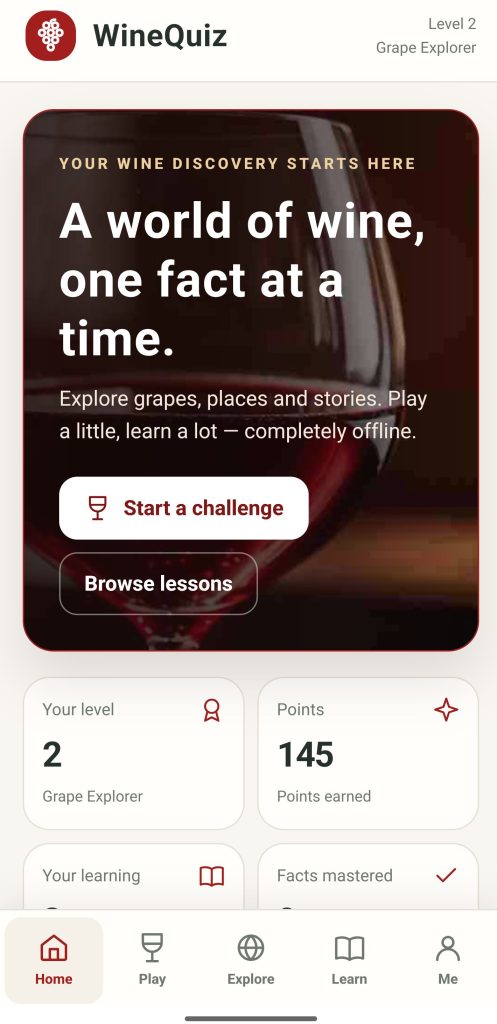
The result is WineQuiz, which has evolved considerably from that first simple experiment. It is now what is known as a Progressive Web App (PWA), meaning that it can be used directly in a web browser or optionally installed as a standalone app on an iPhone, iPad or Android device. Once installed, it can be used offline, making it particularly handy for travelling or filling otherwise unproductive moments.
If you prefer to use it directly through a web browser, that works too. However, your progress is stored locally, so you will need to return using the same browser on the same device to pick up where you left off.
WineQuiz is a free, interactive way to explore and learn about wine. It is intended for anyone with an interest in the subject, from complete beginners to enthusiastic amateurs and those who already have a reasonable amount of knowledge. It combines short educational lessons, multiple-choice questions and a variety of games and challenges. The idea is not simply to test what you know, but to help you learn something new as you go along.
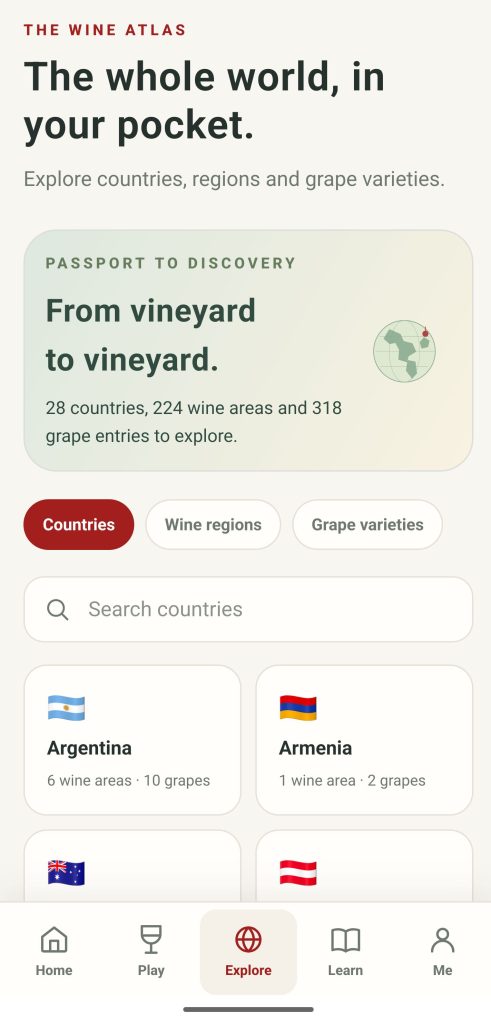
The application has grown more than I originally anticipated. It currently includes 16 learning areas, 730 lessons, 3,169 multiple-choice questions, and interconnected information covering 318 grape varieties, 224 wine regions and 28 wine-producing countries. The learning material covers a fairly broad range of subjects, beginning with wine fundamentals, grape varieties and styles, and progressing through viticulture, climate, soils, terroir, winemaking, maturation and wine chemistry. There are sections devoted to the wines of France, Italy, Spain, Portugal, the rest of Europe, the New World and emerging wine regions. Other topics include sparkling, sweet and fortified wines, tasting and sensory skills, food pairing, storage, buying and serving wine, as well as wine history, regulations, sustainability and the business of wine.
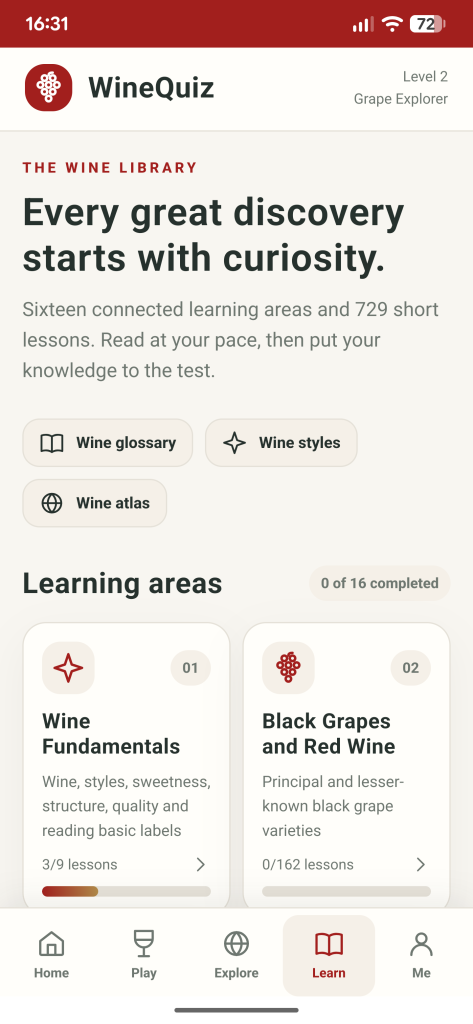
The content is designed to move from relatively straightforward concepts towards more detailed and sometimes quite technical subjects, allowing you to explore according to your interests and existing knowledge. Rather than offering just a conventional question-and-answer quiz, WineQuiz currently has seven different game modes: Quickfire Quiz, World Explorer, Label Detective, Winemaker Studio, Pairing Puzzle, Mystery Wine and Master Challenge. Each approaches wine knowledge from a slightly different angle. Some concentrate on factual recall or wine geography, while others challenge you to interpret fictional wine labels, make winemaking decisions, identify mystery wines or work out suitable food and wine pairings.
Questions are accompanied by explanations, so even when you get something wrong, there is an opportunity to learn why. There is also a revision system that brings back previously studied facts to help reinforce what you have learnt.
As you work through the material, you earn Points, unlock achievements and progress through different knowledge levels. There is no particular route you have to follow. You can concentrate on subjects that interest you, try different challenges or simply see how much you know.
My main aim is to make learning about wine accessible, interesting and entertaining, without making it feel like formal study. It may also be useful as supplementary revision for people taking professional wine qualifications, although that was never its primary purpose. It is intended more as something you can enjoy in your own time, whether you have five minutes over a coffee or several hours to fill on a long journey. Your progress, Points and achievements are saved automatically on your device, and there is an option to export and restore your progress if you want to keep a backup or move to another device.
There will almost certainly be some inaccuracies, omissions or points that could be better explained. WineQuiz should therefore be regarded as an informal educational resource rather than a definitive reference for examinations or professional study.
What began as a way of amusing myself while waiting for a flight has turned into a rather larger project than I ever intended. I have enjoyed creating it, learnt quite a bit in the process and hope that others might find it both useful and entertaining.
If you give WineQuiz a try, I am interested to hear what you think. In particular, please let me know if you spot any factual errors, encounter problems or have suggestions for how it could be improved.