This article was prompted by my review of a 750ml can of wine. It actually made me think more deeply about glass wine bottles. We rarely spare a thought for the everyday bottle sitting on our dining table.
However, look closer. That simple glass bottle is not simple at all. It is a remarkably dense, highly engineered convergence of eighteenth-century international trade mathematics, physical chemistry, photochemical shielding, and a modern, high-stakes battle over supply-chain carbon logistics.
The Trade Mathematics of the Standard Bottle
To understand why wine across the globe is almost universally sold in 750ml vessels, you must look past modern EU directives and step into the trade lanes of the eighteenth and nineteenth centuries.
Before metric harmonisation was codified by the European Economic Community in 1975 (and adopted by the United States in 1979), wine moved across borders in a chaotic patchwork of regional barrels and hand-blown glass jars. Early glass wine bottles were irregular, blown individually by mouth. An artisan glassblower’s output was strictly constrained by human lung capacity and a single exhalation naturally restricted a bottle’s volume to somewhere between 700 ml and 800 ml. However, the eventual standardisation to exactly 750 ml was settled by the practical arithmetic of maritime commerce rather than human physiology.
At the time, France was the world’s primary wine producer, whilst Great Britain was its largest international customer. The French calculated liquid volumes in metric litres, whereas the British traded using imperial gallons. To streamline customs duties, taxation, and shipping manifests, merchant houses established a remarkably neat conversion based on the standard 225-litre Bordeaux oak barrel (the barrique). A 225-litre Bordeaux cask divides cleanly into exactly 300 bottles of 750ml. One British imperial gallon (approximately 4.546 litres) divides into six bottles of 750ml.
Consequently, standard merchant cases were constructed to hold six or twelve bottles representing exactly one or two imperial gallons, respectively. What appears to modern consumers as a comforting, traditional standard was an elegant piece of nineteenth-century Anglo-French logistics accounting.
Regional Silhouettes and Functional Mechanics
While a bottle appears to be a basic glass cylinder, its physical geometry represents a masterclass in structural engineering, designed to survive automated bottling lines and decades of cellar storage.
The physical anatomy of the bottle comprises several critical functional zones:
The Bore and Transfer Bead: The inner neck bore is manufactured to precise tolerances (standardised at 18.5 mm, widening to 21 mm) to ensure airtight seals under cylindrical corks or screwcaps. Just below the mouth lies the bead (or collar), which provides essential mechanical reinforcement, preventing the glass neck from chipping under the immense downward force of automated corking equipment.
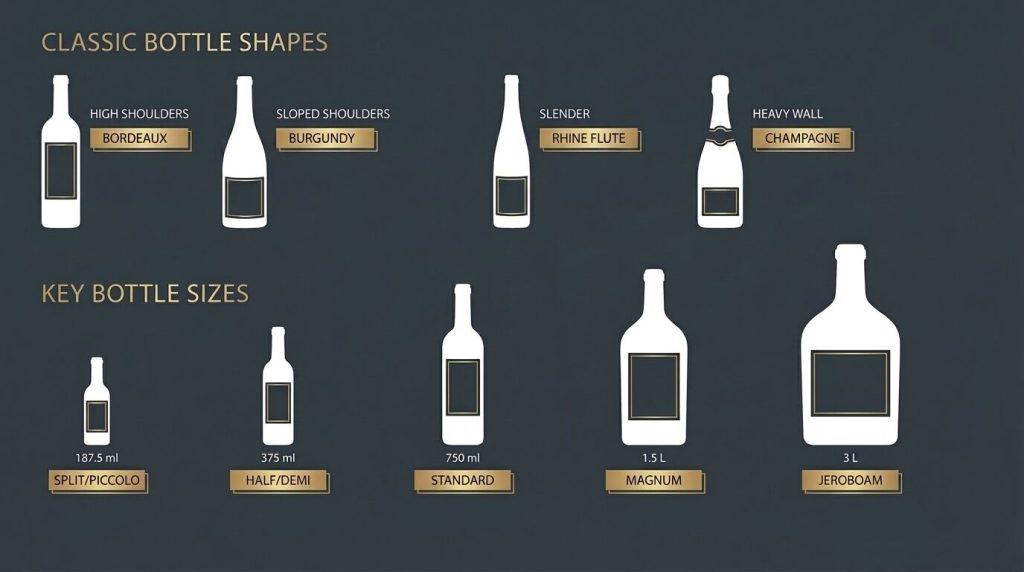
The Shoulders: The shoulder angle represents a functional compromise between aesthetics and sediment management. The classic Bordeaux (Claret) bottle features high, sharp 90-degree shoulders. This shape acts as a mechanical trap. As an aged red wine is decanted, the sharp shoulder catches solid bitartrate and tannin sediment before it reaches the glass. Conversely, Burgundy bottles, used for Pinot Noir and Chardonnay, which throw off minimal particulate matter, feature gently sloping shoulders. This smooth profile was exceptionally fast and cheap for nineteenth-century French glassblowers to produce.
The Rhine (Hock) Flute: Tall, slender, and virtually shoulderless, this silhouette originated in Germany’s Mosel and Rhine valleys. Because these aromatic white wines were shipped on calm river barges rather than rough ocean vessels, the bottles required less structural bulk, prioritising space-saving, tight packing.
The Champagne Bottle: Built specifically for sparkling wines, these bottles feature heavy, thick walls and gentle slopes engineered to withstand internal pressures of 70 to 90 pounds per square inch (psi), more than double the pressure of a standard motor car tyre. The deep indentation at the base, the punt, originated as a by-product of hand-blowing, created when glassblowers pushed the pontil seam inwards so the bottle could stand upright without rocking. In modern manufacturing, the punt is strictly functional as it redistributes internal pressure outwards towards the thick base ring and accelerates heat dissipation during cooling. Surrounding the punt on the lower heel is knurling, a textured pattern of small embossed bars or crescents. Knurling reduces direct contact with metal conveyor belts, preventing thermal shock, reducing glass-on-glass scuffing, and offering vital traction on high-speed industrial lines.
Volume Taxonomy and the Wine Chemistry of Ageing
Wine bottles exist in a vast hierarchy of sizes, most named after biblical kings and patriarchal figures. This naming convention emerged in the nineteenth century as champagne houses sought grandiose titles for their celebratory display vessels.
- Piccolo / Split: 0.1875 L, equivalent to 1/4 bottle, with a serving capacity of 1 glass.
- Demi / Half: 0.375 L, equivalent to 1/2 bottle, with a serving capacity of 2.5 glasses.
- Standard: 0.75 L, equivalent to 1 bottle, with a serving capacity of 5 glasses.
- Magnum: 1.5 L, equivalent to 2 bottles, with a serving capacity of 10 glasses.
- Jeroboam / Double Magnum: 3.0 L, equivalent to 4 bottles, with a serving capacity of 20 glasses.
- Rehoboam: 4.5 L, equivalent to 6 bottles, with a serving capacity of 30 glasses.
- Methuselah / Imperial: 6.0 L, equivalent to 8 bottles, with a serving capacity of 40 glasses.
- Salmanazar: 9.0 L, equivalent to 12 bottles (1 case), with a serving capacity of 60 glasses.
- Balthazar: 12.0 L, equivalent to 16 bottles, with a serving capacity of 80 glasses.
- Nebuchadnezzar: 15.0 L, equivalent to 20 bottles, with a serving capacity of 100 glasses.
- Midas / Melchizedek: 30.0 L, equivalent to 40 bottles, with a serving capacity of 200 glasses.
Bottle volume dictates how wine matures over time. The primary engine of bottle ageing is micro-oxygenation which is the subtle interaction between the wine and the tiny volume of oxygen trapped in the neck headspace (the ullage) and penetrating through the closure. In a standard 750 ml bottle, the ratio of headspace oxygen to wine volume is relatively high. In a 1.5-litre Magnum, however, the volume of liquid is doubled while the neck diameter and ullage air volume remain virtually identical.
This significantly lowers the headspace oxygen-to-wine ratio. Consequently, oxidation occurs at roughly half the rate in a Magnum compared to a standard bottle. This prolonged, gentle maturation allows delicate primary fruit aromas to be preserved while complex tertiary notes, such as leather, forest floor, dried tobacco, and cedar, develop with subtle finesse over decades.
Glass Colour Chemistry and Lightstrike
We frequently admire crisp white and vibrant rosé wines presented in crystal-clear glass bottles. Yet from a chemical perspective, bottling light-sensitive wine in clear glass is a perilous gamble. When light strikes wine, specifically ultraviolet (UV) radiation and short-wavelength blue light in the 370–400 nanometre range, it triggers a destructive photochemical reaction known in sensory science as “lightstrike” (goût de lumière).
The underlying mechanism relies on riboflavin (Vitamin B2), a naturally occurring vitamin in wine. Riboflavin functions as a photosensitiser. Upon absorbing near-UV photons, riboflavin enters an excited molecular state and transfers energy to sulphur-containing amino acids (methionine and cysteine). This energy transfer cleaves the carbon-sulphur bonds, releasing volatile compounds such as dimethyl disulphide and hydrogen sulphide. Within only hours of full light exposure, a pristine wine can develop foul off-aromas resembling wet cardboard, cooked cabbage, damp wool, or drains.
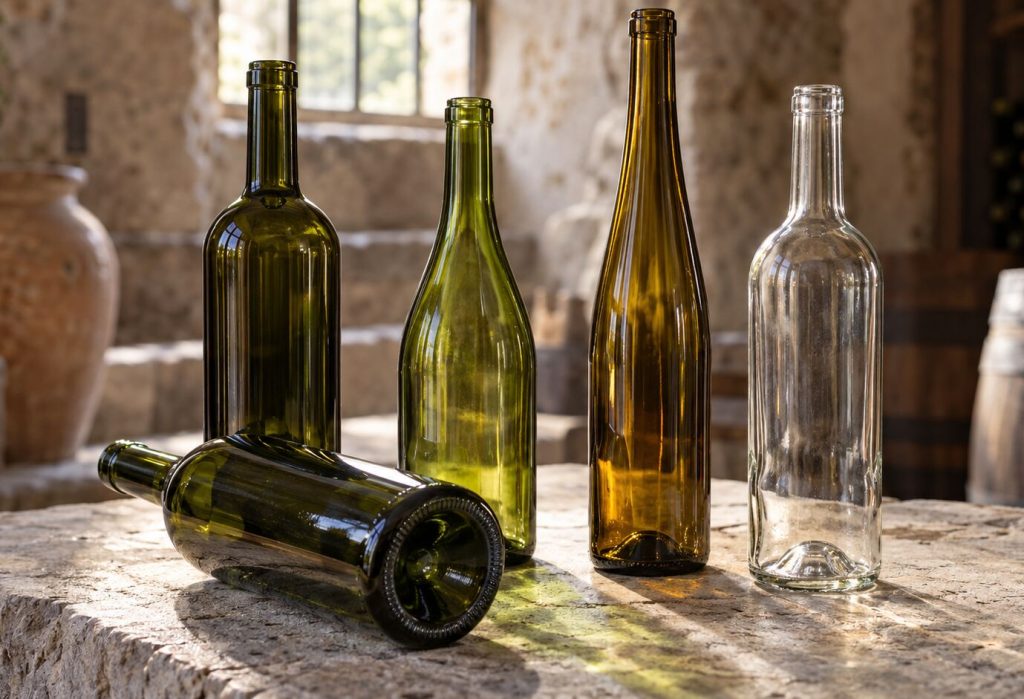
To prevent lightstrike, container glass must function as an optical spectral filter, absorbing damaging light wavelengths below 450 nm. This is achieved by introducing precise metal oxides into the molten silicate batch:
Amber (Brown) Glass: The undisputed champion of photochemical protection. Formed by melting iron, sulphur, and carbon compounds in a reduced furnace atmosphere, it creates an iron-sulphur chromophore that absorbs up to 99% of all radiation below 450 nm. It completely neutralises UV-A, UV-B, and blue visible light.
Antique and Dark Green Glass: The traditional standard for cellar-aged red wines. Formed by adding chromium oxide , it blocks UV light up to 380 nm. However, its protection drops off between 400 nm and 450 nm compared to amber glass. It provides sufficient protection for red wines containing natural protective tannins, but remains somewhat vulnerable under harsh shop display lighting.
Flint (Clear) Glass: Created using manganese or selenium oxides to neutralise iron impurities, flint glass transmits more than 90% of all UV and visible light. It provides zero protection against lightstrike. Wineries using flint glass prioritise retail visual presentation over photochemical stability.
The Lightweighting Revolution and Low-Carbon Glass
Despite centuries of tradition, the heavy glass bottle faces an existential challenge today due to its immense environmental footprint. Life Cycle Assessment (LCA) data reveals that packaging and distribution account for up to 51% of a winery’s total carbon footprint. Glass manufacturing requires fossil-fuelled furnaces operating continuously at temperatures up to 1700°C. Furthermore, transporting heavy glass adds severe freight emissions. A standard filled bottle weighs roughly 1.3 kg, meaning the glass container accounts for nearly 40% of the gross weight being transported across the globe.
To solve this, the international wine sector is executing a rapid lightweighting revolution. This structural evolution is made possible by transitioning from legacy “Blow-and-Blow” (BB) forming to Narrow Neck Press-and-Blow (NNPB) moulding. Traditional BB forming relies on pneumatic air pressure, resulting in uneven wall thickness and structural “thick spots” that add dead weight. NNPB replaces air pressure with a precision mechanical metal plunger that physically presses molten glass into the mould. This guarantees micron-level uniform wall thickness, allowing glassmakers to shed 20% to 30% of bottle weight (dropping standard bottles from 550 g to 380–420 g) without compromising top-load strength or burst resistance.
The shipping economics of lightweighting are effective. Consider a standard 20,000 kg legal road payload limit. A shipping container filled with traditional 550 g glass bottles hits its weight ceiling at 961 cases. The exact same container loaded with 420 g NNPB lightweight bottles fits 1,347 cases before hitting legal limits which is a 40% increase in transport volume efficiency.
Beyond lightweighting standard glass, cutting-edge material innovations are redefining the future container:
LionGlass: Developed by Penn State and Verallia, this glass formulation completely eliminates carbonates from the raw batch, removing direct chemical CO_2 furnace emissions while melting at temperatures 400°C lower than standard soda-lime glass. Mechanically, LionGlass is ten times more crack-resistant, enabling ultra-thin, hyper-lightweight structures.
The Verre Vert Hybrid Bottle: Weighing just 140 g (a 72% weight reduction), this unbreakable container features a durable core lined internally and externally with micro-thin, inert glass. It guarantees zero oxygen transfer and zero taste interaction while eliminating transit breakage entirely.
Circular Glass Networks: Systems like Revino in North America and European deposit return frameworks demonstrate that washing and refilling standardised glass bottles up to 20 times reduces lifecycle carbon emissions by up to 80% compared to single-use recycling loops.
The Sustainable Wine Roundtable (SWR) Bottle Weight Accord is a global commitment by 28 major wine industry leaders, representing 3 billion bottles, to cap the average weight of standard 750 ml still wine bottles at 420g by the end of 2026.
The next time you uncork a bottle, take a moment to admire the glass itself. It is far more than a simple vessel. It is an intricate monument to historical trade, physics, photochemistry and increasingly sustainable industrial design.