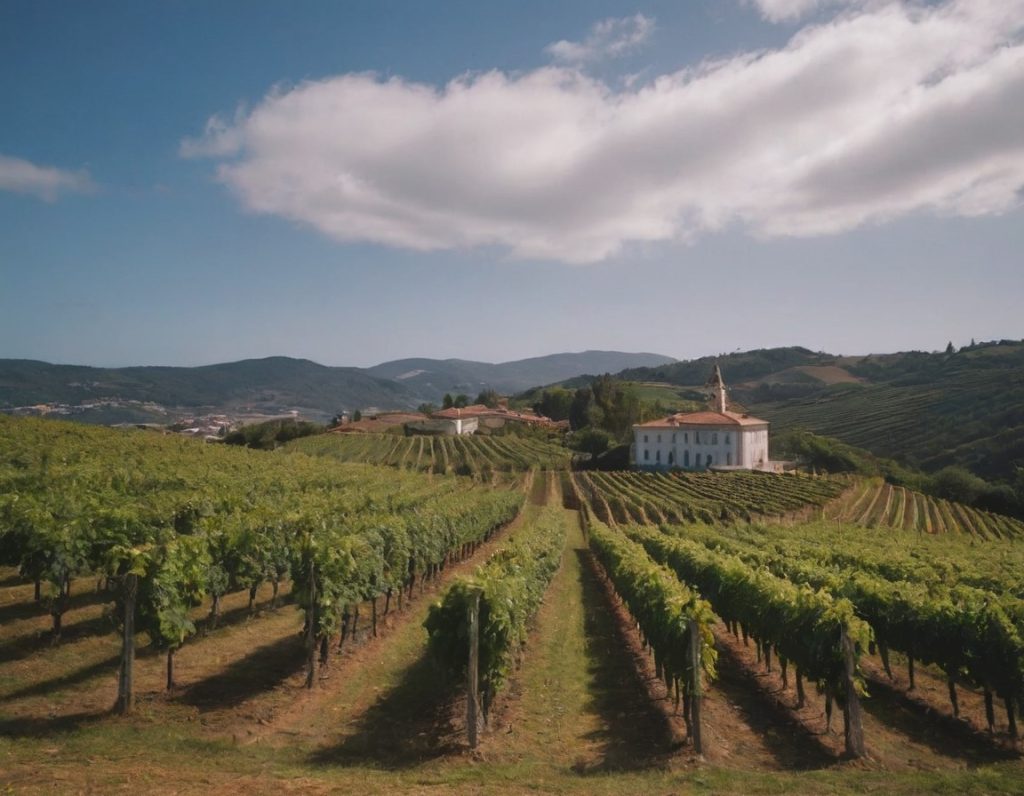
DO Rías Baixas is one of those wine regions whose identity is inseparable from landscape. The name itself comes from Galician and means “lower rías”, with rías being the jagged Atlantic inlets or estuaries that define the south-western coast of Galicia. In the official wine geography, the term is tied to five estuarine systems stretching south from the area below Santiago de Compostela towards Portugal, and that maritime setting is not decorative background but the foundation of the region’s climate, viticulture and taste.
Geographically, Rías Baixas sits in Galicia in north-west Spain, mostly in the province of Pontevedra but also extending into part of A Coruña. Its vineyards are associated with the lower reaches of rivers including the Ulla, Umia and Miño and with tributaries such as the Tea and Louro. The climate is strongly Atlantic: mild, wet, breezy and notably green by Spanish standards, with moderate temperatures, high rainfall and enough sunshine to ripen grapes while preserving acidity. Soils are dominated by granite, with some schist and river-borne alluvial and colluvial deposits of sand, gravel, silt and clay. That combination of humidity, drainage and mineral, acidic soils is central to the region’s freshness and tension in the glass.
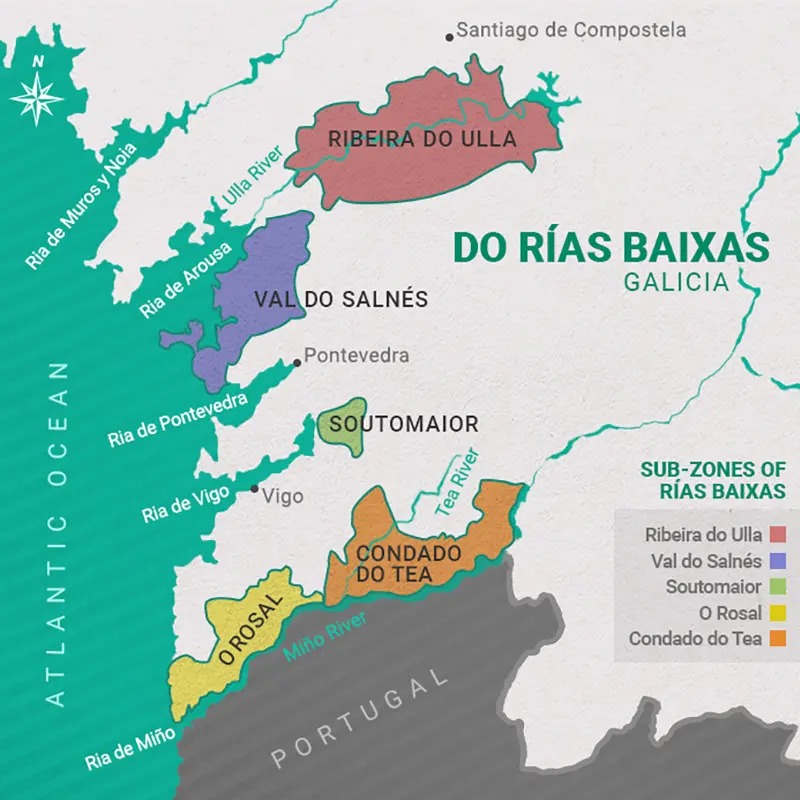
The denomination is divided into five sub-regions, each with its own topography and stylistic accent. Val do Salnés, around Cambados and the lower Umia, is the historical heartland and the coolest, dampest and most maritime zone. It is commonly treated as the birthplace of modern Albariño. O Rosal, on the Portuguese border where the Miño nears the Atlantic, is cooler and coastal, with terraced vineyards and a long tradition of blends. Condado do Tea lies further inland along the Miño and Tea rivers, is warmer and drier, and often yields broader wines. Soutomaior, the smallest sub-zone, sits in the hills at the head of the Ría de Vigo on sandy soils over granite. Ribeira do Ulla, the newest sub-zone, was incorporated in 2000 and lies inland to the north-east, around the Ulla basin near Santiago de Compostela.
History
The region’s history is older than the DO itself. The official account links the wider area to Celtic settlement, followed by Roman viticulture and trade, and later to the cultural pull of the Camino de Santiago. As for Albariño, folklore long credited monks with bringing it in, but the denomination’s own educational material now says the leading theory, backed by genetic research, is that Albariño is native to Rías Baixas and especially well adapted to its cool, wet conditions. In institutional terms, the modern quality framework began in 1980 as Denominación Específica Albariño, before becoming DO Rías Baixas in 1988, after Spain joined the European Community and wine law no longer allowed a region to be named for a single grape.
Rías Baixas DO
Although Rías Baixas is synonymous with Albariño, the legal picture is richer. The current specification authorises seven white grapes: albariño, treixadura, loureira, caíño blanco, torrontés, godello and ratiño gallega; and eight red grapes: caíño tinto, espadeiro, loureiro tinto, sousón, mencía, brancellao, pedral and castañal. Even so, Albariño overwhelmingly dominates. The official specification says it accounts for more than 96% of harvested grapes in recent vintages, and the 2025 harvest was reported at 96.99% Albariño. White secondary varieties, especially caíño blanco, loureira, godello and treixadura, play an important supporting role in some sub-zones, while reds remain well under 1% production.
That grape mix produces a surprisingly broad family of wines. Legally, the denomination covers generic white Rías Baixas, 100 per cent Rías Baixas Albariño, the sub-zone expressions Rías Baixas Condado do Tea, Rías Baixas Rosal, Rías Baixas Salnés and Rías Baixas Ribeira do Ulla, plus Rías Baixas barrica, Rías Baixas tinto and quality sparkling wines made by second fermentation in bottle. In style terms, the classic image remains pale, bone-dry, aromatic white wine with high natural acidity and flavours running through citrus, apple, white peach, apricot, melon and flowers. Yet the region has expanded beyond the stainless-steel stereotype: lees-aged examples, barrel-aged whites, sparkling and small-production reds are all part of the contemporary scene. As a rough stylistic guide, Val do Salnés is often the crispest and most maritime expression, O Rosal tends towards softer and peachier wines, and Condado do Tea often gives fuller, warmer and more earthy examples.
Sales
For sales in calendar year 2025, the most useful official measure is the number of guarantee seals, or contraetiquetas, issued by the Consejo Regulador. Rías Baixas finished 2025 with 36,157,121 seals, up 3.05 per cent on the previous year, and 27,117,841 litres of wine verified by the control and certification body. The regulator said that kept the denomination above the threshold of 36 million bottles sold. Spain remained the principal market, while exports accounted for around 31.89 per cent of total volume and involved 108 wineries during the year.
Exports
For 2024/25, exports rose 6.82 per cent by volume and 7.20 per cent by value to 8,378,501 litres, equivalent to 11,171,334 bottles, worth €66,740,014. The wines reached more than 107 countries, and exports represented 31 per cent of the denomination’s total sales. The average ex-cellar export price rose to €7.97 per litre. By volume, the top foreign destinations were the United States, the United Kingdom, Puerto Rico, Ireland, Mexico, the Dominican Republic, Sweden, the Netherlands, Belgium and Canada. Geographically, the Americas accounted for 55.91 per cent of exported volume and the EU for 35.61 per cent.
Rías Baixas and the UK
The UK remains one of the denomination’s most important foreign homes. In May 2025, Rías Baixas said the British market had come close to 1.2 million litres in 2024, worth almost €9 million, confirming the UK as the second export market overall and the first in ‘Europe’. The regulator also said 77 wineries were exporting there at that point. By the end of the 2024/25 export campaign, the UK still ranked second by volume, 82 wineries were selling into the market, and export value to the UK had risen by 14.90 per cent. In other words, the UK is not simply a legacy Albariño market for Rías Baixas. It remains one of the denomination’s most resilient and strategic outlets, especially for premium Atlantic whites whose profile suits British demand for seafood-friendly, high-acidity wines.
Rías Baixas Outlook
What makes DO Rías Baixas especially compelling today is that it manages to be both recognisable and diverse. Its image is still anchored by Albariño, pergola-trained vines, fragmented smallholdings and the Atlantic edge of Galicia, but the denomination has grown into something broader. A region of sub-regional nuance, renewed interest in blending grapes such as loureira and treixadura, serious work with lees and oak, a tiny but meaningful red category and a sparkling segment that continues to develop. The 2025 figures show a denomination that is not standing still. Sales continued to rise, exports strengthened again, the UK held its place among the two most important foreign markets, and the 2025 harvest was the largest on record, at 47.5 million kilos of grapes, with excellent reported quality. That is why Rías Baixas matters now not just as the home of Albariño, but as one of Europe’s clearest examples of how an oceanic region can turn freshness, precision and local identity into long-term commercial strength.