This one is a bit different as it’s a wine I’ve held onto for 10 years. Normally, I focus on wines that are ready to buy and drink straight away. I don’t usually store or age bottles. But this one’s got a story behind it and it’s taught me a thing or two, particularly about declassified wines.
It was part of my wine journey in 2015. Back then, my wife and I, sometimes with friends or family, attended tastings run by Arthur Till. Arthur had retired slightly early after a successful career in senior management for the European arm of a major American company. He’d developed an interest in wine back in the 1970s, when he’d hire a van and drive down to Bordeaux to bring back interesting but lesser-known bottles. In retirement, he decided to take that interest further. He believed retirement was the right time to take a few risks and try new things without worrying about the financial outcome. He took a rigorous six-week teacher training course and went on to teach wine appreciation. He also set up a local wine group, organised trips and later branched out into corporate wine training. His approach to wine was practical and down to earth and, ironically given what I did with this wine, he encouraged people to enjoy wine rather than save it, which is very much my own view now too.
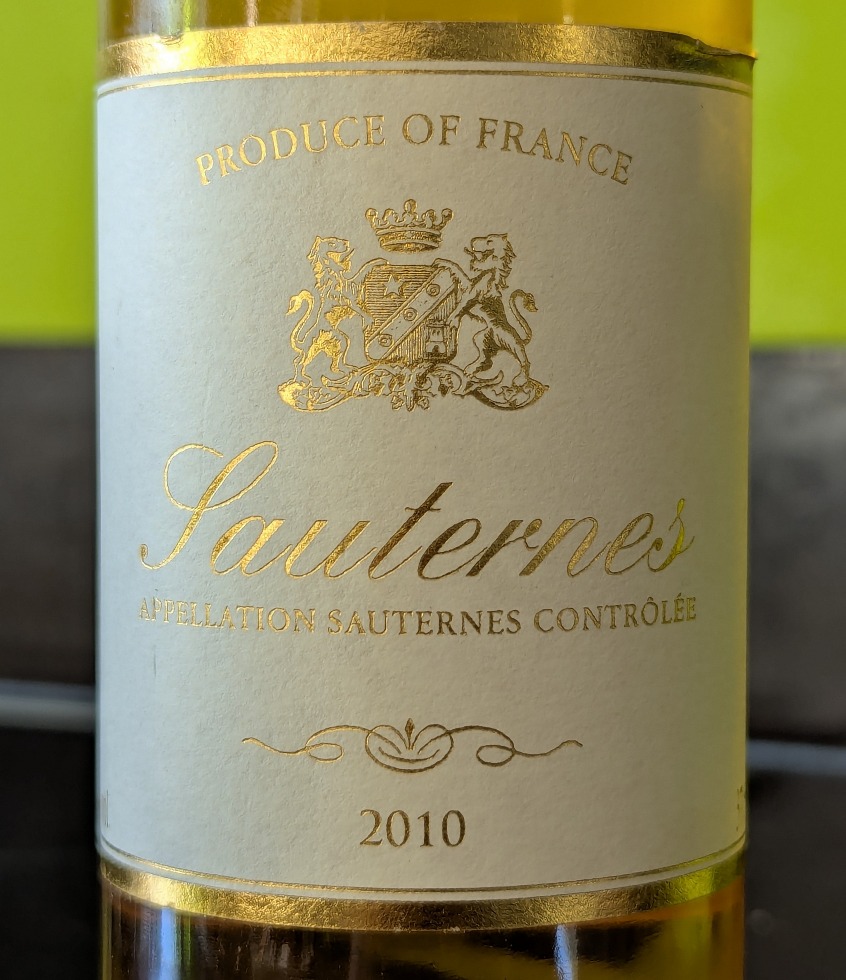
In 2015, ten years ago now, we were attending quite a few of Arthur’s courses and on one occasion my wife and I tried a declassified Sauternes. What happens is that some top châteaux produce more wine than they actually want to release under their main label. To maintain the perceived rarity and value of the name, they hold some of it back. The rest gets sold off at a lower classification, often at a fraction of the original price and typically under a more generic merchant label. It’s still made to the same standard, just without the prestige attached.
Arthur was really convinced that the bottle we tried was actually from Château d’Yquem that then sold for £200+ per bottle. He rang up KWM Wines & Spirits, the supplier and asked. The person on the phone didn’t know, so shouted across the room to someone else. Someone in the background replied that it was Château d’Yquem, but not to say so. The response Arthur got was that they couldn’t confirm either way. We subsequently bought three bottles at £14.95 each. We opened one straight away and I put the other two aside. They’ve been stored reasonably well since then, certainly not ideal conditions, especially in the warmer summers we’ve had, but nothing disastrous.
The second bottle I’ve just opened is from the 2010 vintage, 14%. It’s still in perfectly good shape. It hasn’t darkened much and shows no signs of spoiling. Unfortunately, I can’t quite remember how it tasted back in 2015, but this bottle is not overly sweet, certainly not sickly. There’s a slight oiliness when it first hits the tongue, then it spreads gently across the mouth. It’s very smooth, with flavours of dried fruit, raisins, nuts, butterscotch and marmalade. Someone I shared it with said it had a bit of a back edge which I also translated as a lingering depth to the finish. We tried it with cheese, including Roquefort, and it was a brilliant match. I’m pleased it’s held up this well, but I’m not sure how much longer the third bottle will last.
Was it worth keeping it? Probably not, but it’s fun. I’ve had sweet wines from newer vintages that were just as excellent, so while the experience was enjoyable, it wasn’t necessarily better than something more recent.
KWM are currently listing a Sichel Sauternes 2020, declassified Bordeaux, at £16.52. I haven’t tried it, and I’m not sure if it’s related to the wine I bought all those years ago. It might be worth a look but it could just as easily be something completely different.