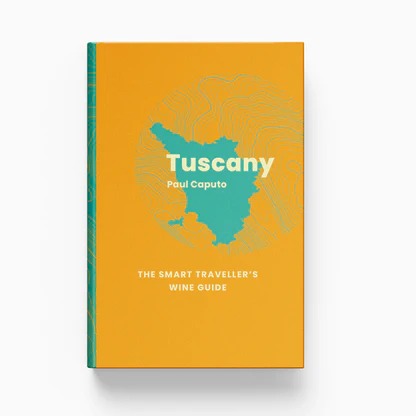
I picked up Tuscany – The Smart Traveller’s Guide because a trip to the region is looking increasingly likely, prompted by a friend who has recently bought a property near there. What I found was a compact but impressively wide-ranging book that works equally well as background reading at home and should be a practical companion once on the ground.
The guide is written by Paul Caputo, an award-winning freelance writer whose background in wine, spirits, fine dining and luxury sustainable travel is evident on every page. With two decades of travel behind him, thousands of wines tasted each year, judging experience at international competitions and writing for Decanter and The Buyer, his authority feels assured.
The book opens with a concise but absorbing history of wine in Tuscany, beginning in the eighth century BCE and moving through the Middle Ages to the major shifts of the eighteenth century, when some of Europe’s first attempts at appellation regulation emerged. This historical grounding makes the later discussion of DOCGs, DOCs and IGPs far more meaningful, and the narrative carries smoothly through to the present day.
From there the focus shifts to geography, breaking the region down into western, central and eastern Tuscany. Caputo explains the remarkable diversity of soils, the varied terrain and the influence of weather patterns in a way that clearly links landscape to wine style. The section on grape varieties follows naturally, covering red and white grapes and drawing a clear distinction between indigenous varieties and international varietals, with thoughtful commentary on why both matter.
One of the strongest parts of the book is the detailed explanation of the Italian classification system. Concepts such as Riserva, with its extended ageing requirements, and Superiore, with its lower yields, are set out clearly, alongside an insightful discussion of how climate change is beginning to disrupt long-established norms and force regulatory adaptation.
The wine section itself is both thorough and engaging. The differences between the two Chianti classifications are clearly explained, with Chianti Classico properly rooted in its older, original territory. Brunello di Montalcino is treated with appropriate depth, as is Vino Nobile di Montepulciano, including an honest assessment of the challenges it faces, partly due to ongoing confusion with Montepulciano d’Abruzzo. Bolgheri, Vernaccia di San Gimignano, Vin Santo and other key wines all receive well-judged coverage, alongside a useful overview of the best Tuscan vintages and a curated list of ten wines to seek out.
For travellers, the visiting information is particularly helpful. Caputo covers when to go, key festivals and major towns including Florence, Siena, Pisa, Lucca and Montalcino. In each case there is guidance on what to see and, crucially, where and what to eat, complemented by practical advice on wine routes that makes planning feel straightforward.
A separate section titled ‘The Guide’ brings together listings for wineries with accommodation, hotels, restaurants, trattorias and enotecas. A particularly appealing touch is the inclusion of places where winemakers themselves like to dine, adding an extra layer of insight.
Along the way, the book weaves in engaging contextual stories, from the origins of the black rooster symbol to the Brunellogate blending scandal and the evolution of the Super Tuscans. These moments of narrative colour prevent the guide from ever feeling purely functional.
Physically, the book size is practical. At 178 by 115 millimetres, with 204 pages, it is small enough to slip into a bag while travelling but substantial enough to be genuinely useful. One minor oddity is that the map printed on the inside cover appears again on page ten, though this is more curious than problematic. It is also worth noting that the book is written in American English, which may jar slightly for some readers.
Published in June 2025, the guide feels thoroughly up to date, particularly in its treatment of climate and regulation. With a recommended retail price of £12.99 or $17.95, it represents great value for anyone interested in Tuscany, whether their primary motivation is wine, travel or, ideally, both.
I have arranged, with the publishers, 15% off this book if you use the code WINEDRINKER15. This isn’t part of any affiliate programme, I don’t receive anything if you use it.