, ,

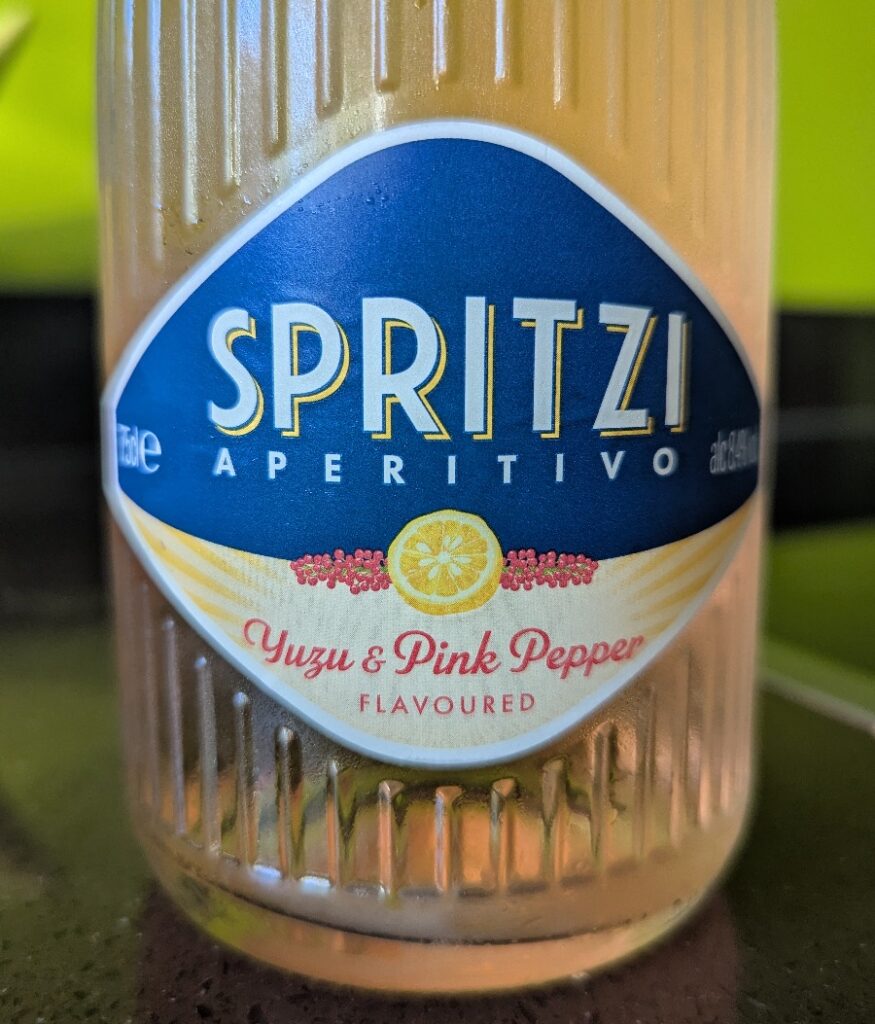
Spritzi Yuzu & Pink Pepper Aperitivo

Posted by

I first came across this drink at a recent Tesco press tasting. Usually, I’m guilty of ignoring anything that doesn’t fall neatly into my admittedly narrow definition of wine. But I was glad I made an exception here. Among the Spritzi flavours on offer at the tasting, Elderflower, Blood Orange and Yuzu & Pink Pepper, it was the latter, a new flavour, that stood out for me. Curious and impressed, I made a mental note to revisit it properly.

Since then, a bottle had been quietly languishing in the fridge, waiting for its moment. That moment came with the recent stretch of hot weather, when I wanted something refreshing, not too strong (8.4% ABV) and definitely very cold.

Spritzi Yuzu & Pink Pepper is a play on the classic spritz, drawing from Italian aperitivo culture. Traditionally, a spritz, originating in Padua, Italy in 1919, is made with Aperol, Prosecco and soda water, known for its bittersweet and lightly sparkling character. This drink definately isn’t Italian, though. It’s made in Germany by Peter Mertes KG, particularly well known for its Riesling wines and is an aromatised wine-based beverage, meaning it’s primarily white wine (72%), carbonated water and added flavourings.

Tesco describes it as citrusy with a delicate pink pepper spice and suggests it as an alternative to a G&T. It pours a lovely rosé colour and has a soft fizz, something like a frizzante wine. It’s sweet, but not in a cloying way, with a balancing bitterness that adds complexity. From the first sip, especially served ice cold, it’s incredibly refreshing, almost sorbet-like.

The flavour profile is intriguing. There’s obvious citrus yuzu being a tart, aromatic Japanese fruit but also tropical notes like passionfruit, mango and lychee. There’s a distinct echo of vermouth or Cinzano in the background, with subtle botanicals and a touch of bitterness. It doesn’t taste like wine but that’s part of its charm. It plays with contrast in a similar way, to sweet and sour sauce, the interplay between sweetness and bitterness makes it both accessible and grown-up.

It works on its own, but also stands up surprisingly well with food. In the heat, when you want something cool, crisp and not overly alcoholic, it fits the bill perfectly. And at only £5 from Tesco, £4.50 when I picked it up on promotion, it’s a great-value summer option. I’ll definitely be heading back to buy more.
Follow

Did You Know?

In 2024, the UK was the second-largest export market for Champagne globally, after the United States. More

Local UK bottling of wine represents about 40% of imported wine. More

Around 1% of people, typically severe asthmatics, have a sulphite sensitivity. More

A large 80% of Australian wine arrives in the UK in bulk. More

Only about 0.02% of Australia’s landmass is dedicated to vineyards. More

In 2024, New Zealand produced only 1% of the World’s wine. More

In 2024, the US imported 37% of World production of Pinot Grigio and the UK was is in second place at 27%. More

In 2024, the UK was South Africa’s largest export market, with 40% of total exports. More

In 2024, the United Kingdom imported 22.3 million bottles of Champagne, a decline of 12.7% compared to the previous year. More

Larger Champagne producers source grapes from as many as 80 different vineyards throughout Champagne. More

Champagne houses and growers collectively produce around 300 million bottles annually. More

In 2025, the Champagne region was home to about 2,124 Champagne houses and approximately 19,000 growers. More

Provence is one of the leaders in the conversion to organic viticulture, with 61% of vineyards certified. More

8% of the South Africa’s grape production is Fairtrade-certified. More

Up to 80% of wine aroma compounds come from grape skins. More

Glycerol is the third-largest component of most dry wines after water and alcohol which is why they so often feel ‘smooth’ or ‘silky’ in the mouth. More

Humans are more than 400 times more sensitive to bitter than sweet. More

Humans can detect the earthy molecule geosmin at about 100 parts per trillion and camels are so sensitive to it they can locate damp ground from roughly 50 miles away. More

During the phylloxera crisis of the nineteenth century, 90% of Europe’s vineyards were destroyed. More

In 2025, for La Vieille Ferme, also known as “The Chicken Wine”, sales surged by 49.4% to £110.8 million. More

In 2025, in the UK, Yellow Tail held the top position with sales, marking a 9.8% increase over the previous year. More

In 2024, the UK was the second-largest wine importer in volume and value. More

In 2024, the UK was the fifth-largest wine-consuming country globally. More

In 2025, global wine consumption continued its downward trend, estimated at 214.2 million hectolitres, the lowest since 1961. More

In 2025, online alcohol sales had a 20% increase in value over five years. More

In 2025, the number of UK vineyards rose to 1,104 and wineries to 238, with land under vine expanding to 4,841 hectares, a 510% increase since 2005. More

Moët Hennessy alone commands nearly 46.66% of the Champagne market, with the top three producers together holding about 61%, and the top five controlling over 72%. More

In 2024, the Champagne market was worth roughly €3.92 billion. More

In the marketing year 2023/24, white wine accounted for roughly 55% of Spain’s output, whereas red and rosé together made up about 45%. More

In the UK, 92% of wine is consumed within 48hrs of purchase. More

The majority of wines, 95%, use commercial rather than wild yeast. More

Between 0.5 and 10 litres of water, per litre of wine, are needed for cleaning during winemaking. More

Machine harvesting can achieve up to 100 tons of fruit per day vs 1 ton for a human. More

In Germany, 2025 was the smallest wine vintage since 2010. More

The majority of vineyards, 90% in 2019, are farmed with heavy chemical interventions. Only 6% are organic. More

90% of low and coastal areas in south Europe and California will no longer be able to produce good wine by the end of the century. More